How to Respond to a Negative Google Review Without Violating HIPAA

Dental SEO
08 May
Last updated: 26 May
You just opened your Google Business Profile (GBP) and saw a one-star review. It claimed your hygienist was rude, the office was filthy, and you even charged for work the patient didn’t agree to.
You know every word is wrong and you can prove it. Your fingers are already on the keyboard.
Stop.
That response could cost your practice $50,000! That’s the exact penalty the Office for Civil Rights handed a North Carolina dental practice for replying to a Google review with patient details.
We’ve worked with enough dental clinics to know it happens somewhere in the U.S. every month because the owners have no idea about these rules.
To help clear out your confusion, we created this guide covering:
- What HIPAA allows in a public response,
- The templates our dental SEO team uses with the practices we manage,
- When a review is worth flagging for removal, and
What to do after you reply so one bad review doesn’t hurt your local rankings.
Yes, Replying to a Google Review Can Violate HIPAA
You might think HIPAA only kicks in when you share medical details, but many things are involved here.
The moment you confirm someone is your patient, you’ve disclosed protected health information (PHI). That’s true even if the reviewer named themselves, posted photos, and detailed their treatment plan in their review. They can talk about themselves all day, but you can’t.
The OCR has been making this point with real money:
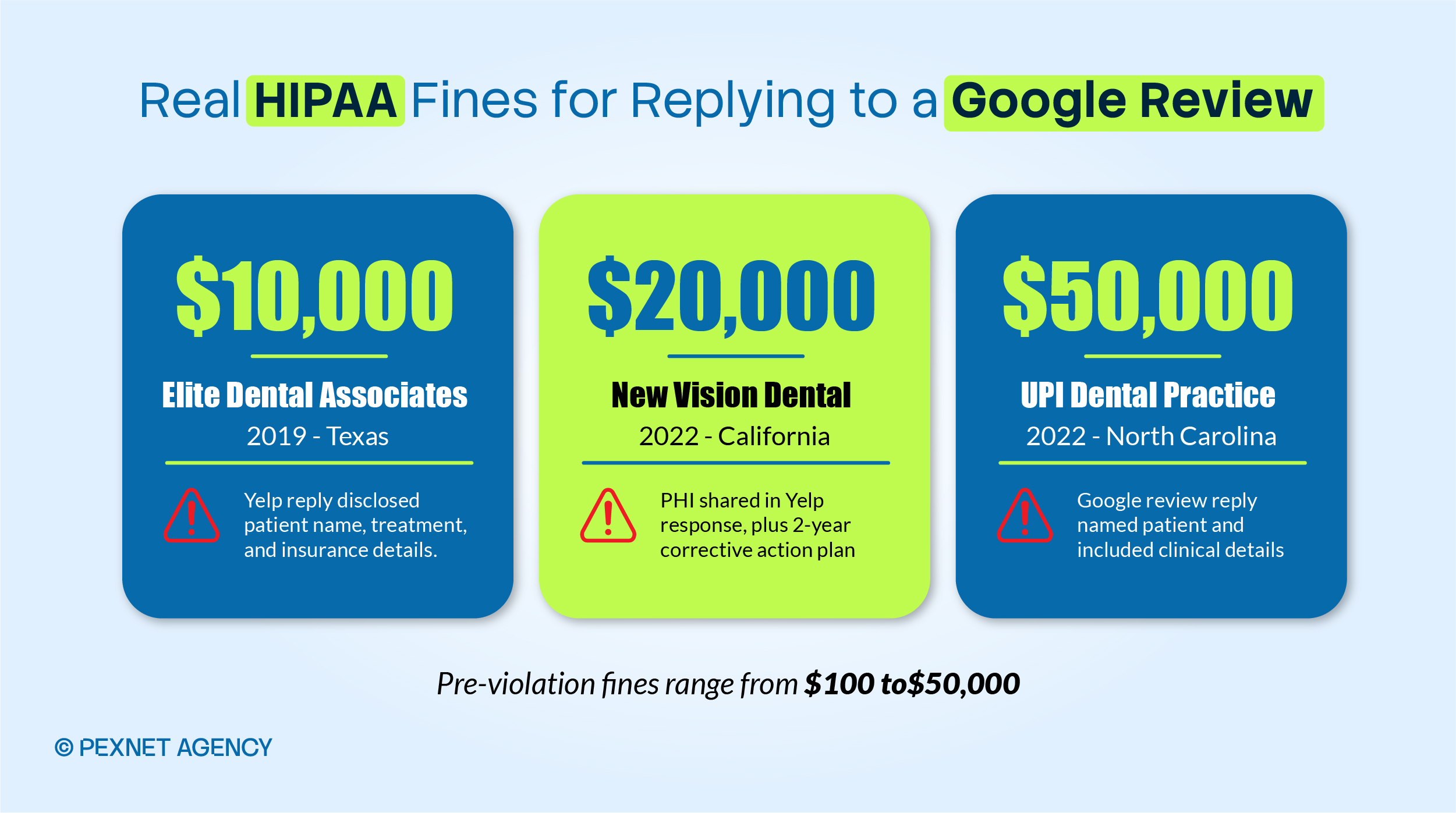
- Elite Dental Associates (2019): $10,000 settlement after replying to a Yelp review with the patient’s name, treatment details, and insurance information.
- New Vision Dental (2022): $23,000 fine plus a two-year corrective action plan for posting PHI in a Yelp response.
- U. Phillip Igbinadolor, D.M.D. & Associates (2022): $50,000 penalty for responding to a Google review with the patient’s name and clinical details, then refusing to cooperate with the OCR investigation.
Per-violation HIPAA fines run from $100 to $50,000, with an annual cap that can reach $1.5 million.
Also, state dental boards add another layer to that. For instance, an Iowa dentist once faced board sanctions for the same kind of public reply.
What You Can’t Say in a Response
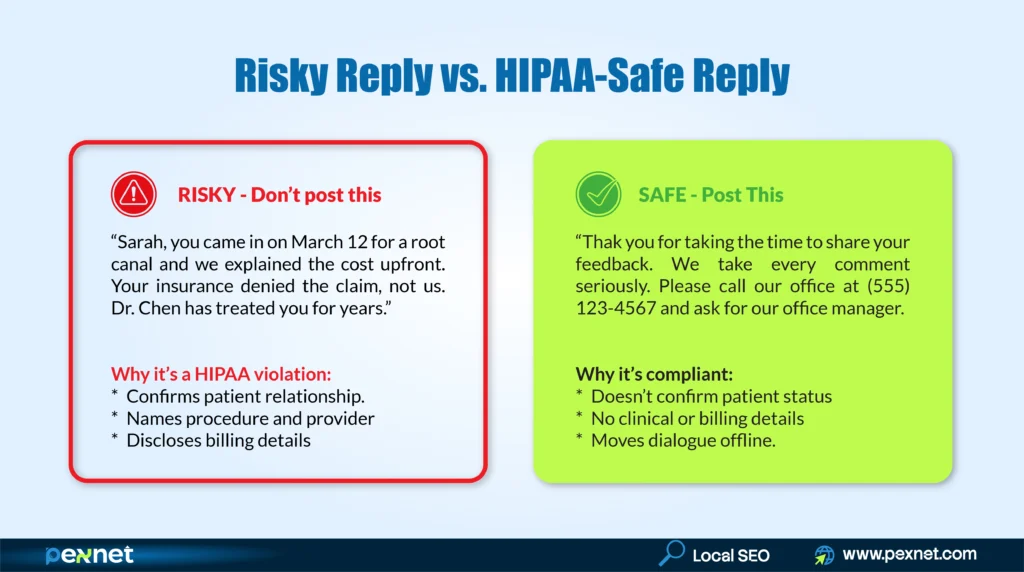
Since these three things will get you in trouble, we coach every dental client on these:
- Confirming the person is (or was) a patient: Even a phrase like “we’ve reviewed your file” acknowledges a treatment relationship.
- Mentioning any clinical details: Procedures, diagnoses, dates of visits, what they were billed for, who treated them – all PHI.
- Referring to “your case,” “your visit,” or “your treatment:” The same problem just in a subtler form.
Here’s a quick test we recommend:
Read your reply assuming the reviewer is a stranger off the street. If a single phrase suggests they had any interaction with your practice, rewrite it.
How to Respond to a Negative Google Review Without Violating HIPAA
When one of our client practices gets hit with a negative review, we run the same four-step process below:
Step 1: Wait at Least 24 Hours
Believe it or not, nothing good gets typed in the first hour after reading a bad review.
We tell our clients to take a screenshot, save the URL, and walk away. The review will still be there tomorrow, and you can reply when your judgment is sharper.
Step 2: Check Whether It Qualifies for Removal First
Before you respond, see if Google might pull the review. We’ve covered this in detail below. If removable then you don’t need to reply.
Step 3: Investigate Internally Without Disclosing Anything
Your front desk and clinical team should piece together what happened. That’s between you and your team.
Step 4: Draft a Professional Response
Keep it short and neutral. Direct any further conversation off the platform.
HIPAA-Safe Response Templates
Here are the formats we use for our dental clients. You’ll see each one is generic enough to comply with HIPAA while still showing future readers that you take feedback seriously.
Template 1: General Response
Thank you for taking the time to share your feedback. We take every comment seriously and work tirelessly to improve our patient experience. If you’d like to discuss your concerns directly, please call our office at [phone] and ask for the office manager.
Template 2: Reviewer Claims a Billing or Service Issue
We appreciate you sharing your perspective. Our office takes billing and service concerns seriously and we’d welcome the chance to look into any specific issue. Please reach out to our office manager at (phone) so we can speak privately.
Template 3: Reviewer Makes Accusations You Believe Are False
Thank you for the feedback. We strive to provide every visitor with a positive experience and we’re sorry to hear yours didn’t meet that standard. Please contact our office manager at [phone] to discuss further. We’d appreciate the chance to address your concerns directly.
Notice these templates do not:
- Confirm the reviewer is a patient
- Reference any procedure, date, or staff member
- Engage with specific claims point by point
- Express anger, defensiveness, or sarcasm
Note: That last one matters. The North Carolina practice that had to pay the $50,000 penalty didn’t just disclose PHI – their reply mocked the patient’s intelligence. As a result, OCR classified the violation as “willful neglect,” which is the most expensive tier.
How to Get a Negative Google Review Taken Down
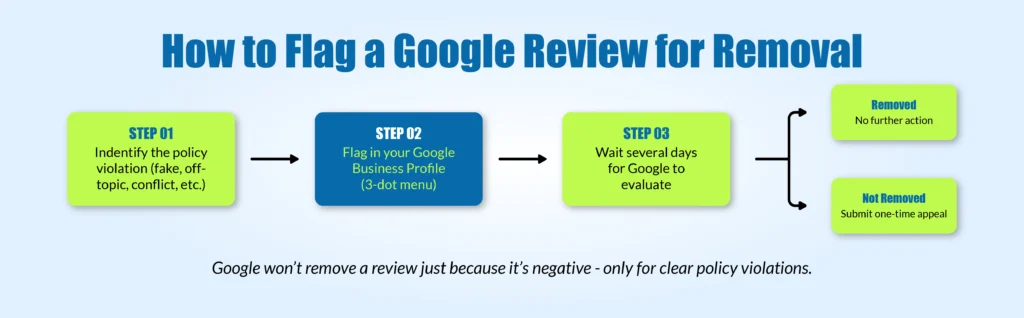
Google won’t remove a review just because it’s harsh, unfair, or wrong. They remove reviews that violate specific content policies.
Here are the violations we see most often with dental clinics:
- Fake Reviews: Posted by someone who never visited the practice, usually with no detail or with details that don’t match what your clinic actually offers.
- Conflict of Interest: A competitor, disgruntled former employee, or their family member.
- Off-Topic Content: Political rants, complaints about something unrelated to dental care, or reviews meant for a different business.
- Hate Speech, Harassment, or Personal Attacks: Slurs aimed at staff or any protected class.
- Private Information: A reviewer who shares a staff member’s home address or personal phone number.
- Duplicate or Spam Reviews: The same person posting different reviews from different accounts.
Here’s the flagging process:
- Sign into your Google Business Profile.
- Open the Reviews section, find the offending review, and click the three-dot menu.
- Select “Flag as inappropriate” and pick the violation that fits.
- Submit, and then check the Reviews Management Tool every few days for status.
- If Google says “no policy violation” and you disagree, use the one-time appeal option.
Remember, flagged reviews usually don’t get removed on the first try. In fact, reviews that read like real customer experiences (even if biased) almost always stay up. Save your flagging energy for clear violations.
For complex situations involving defamation or coordinated review attacks, document everything, including screenshots, reviewer history, timing patterns.
Now, consider escalating through Google’s product expert forums or, in extreme cases, working with a defamation attorney.
What to Do After You Respond
Keep in mind that just one unanswered or poorly-handled negative review at the top of your profile is super bad. However, that same review buried under 30 recent five-star reviews barely registers.
Here’s what we do for our dental clients after a negative review hits:
- Send Review Requests to Your Last 30 to 60 Happy Patients
Use a HIPAA-compliant text or email tool. Don’t gate them by sentiment because Google considers review filtering a policy violation.
- Respond to Your Existing Positive Reviews Too
A 100% response rate signals an engaged, trustworthy practice to both Google and prospective patients.
- Track Your Average Star Rating Monthly
A drop from 4.8 to 4.6 can cost you a Map Pack ranking. The fix is volume without panicking about it.
- Audit How the Review Affected Your Profile
If your overall rating dropped enough to push you out of the top three in your area, that’s a local SEO problem worth digging into.
We’ve watched practices recover from a 1-star bombshell in under 60 days just by stacking 20 to 30 fresh, real reviews on top. Yes, the negative one still stays, but it stops mattering.
Quick-Check: Is Your Response Safe?
| Check | Pass | Rewrite |
| Could a stranger read this and not know if the reviewer is a patient? | ✓ | ✗ |
| Does it stay under four sentences? | ✓ | ✗ |
| Does it route the conversation to a private channel? | ✓ | ✗ |
| Is it free of clinical, billing, or treatment specifics? | ✓ | ✗ |
| Is the tone neutral, not defensive? | ✓ | ✗ |
If you mark ✗ on any single row, don’t post it.
How We Can Help
It’s tricky for a busy dentist to reply to a negative Google review without violating HIPAA.
At Pexnet, we run a dedicated dental SEO team that handles review monitoring, response coaching, and local ranking strategy for dental clinics across the U.S. If you’d rather have someone watching your Google Business Profile and managing this for you, we’d be glad to help.

Md Riadul Islam
Carpet Cleaning SEO Specialist
With over 10 years of experience, Riadul is passionate about helping local, independent businesses succeed.
He’s now focused on AI’s impacts on niche websites since aside from Google, people are also using different AI platforms for carpet cleaning services.
He found that while Google cares about content relevance and website authority, AI relies more on trust and credibility to determine recommendations. That’s why he prioritises strengthening trust signals for our clients.
Riadul believes that sustainable growth comes from combining strong branding, deep customer trust, and smart SEO approaches. At Pexnet, he shares the strategies, frameworks, and real-world lessons he has refined over a decade.
Get Quality Leads from Us
PexNet Newsletter - Subscribe for SEO news, trends, updates, & more.
Share this job post


Related Posts



We’re All Ears!
A simple, open conversation can create new doorways to your professional and business success. Don’t hesitate. Take the first step right now.