Dental SEO Tips & Hacks to Get More Patients

Dental SEO
23 April
Last updated: 26 May
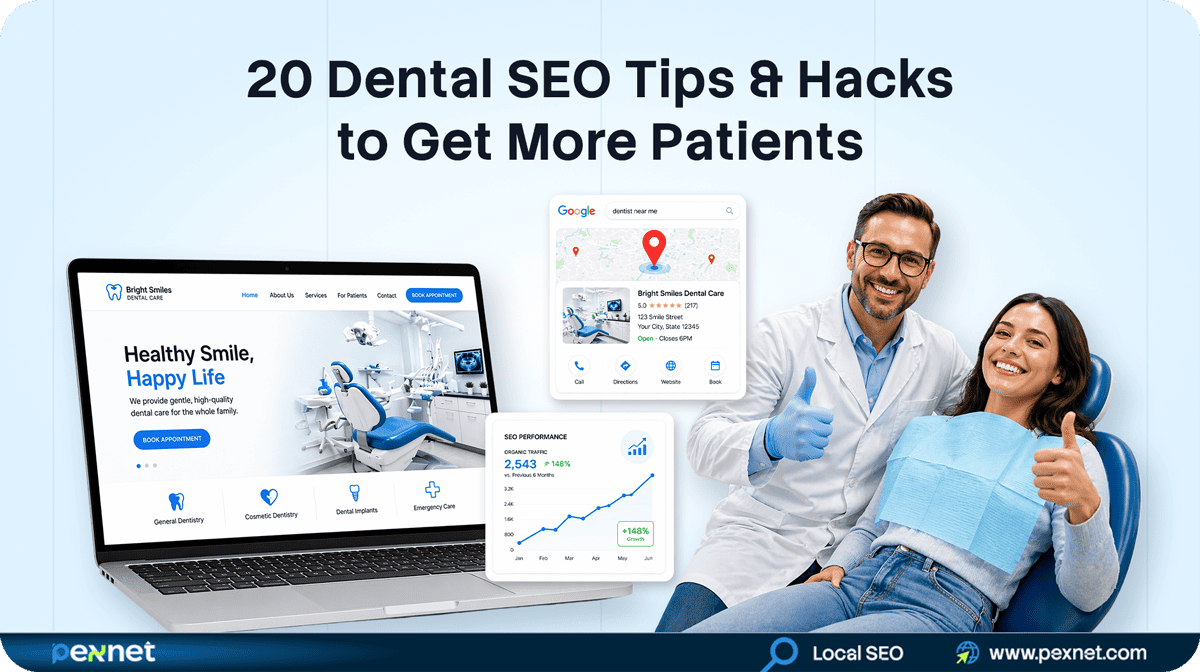
Did you know that 77% of patients now use search engines before booking a healthcare appointment? If your clinic isn’t showing up in local search results, those patients are booking with someone else.
To help you secure your place on the local map pack, Pexnet’s dental SEO specialists shared these dental SEO tips. organized by category so you can start with the quickest wins and work your way up. By the end, you’ll know exactly what to fix, what to build, and what to stop ignoring.
20 Dental SEO Tips that Work in 2026
These tips come from our real experience. After working on more than 150 dental websites worldwide, we’ve seen what works and what doesn’t. So, we’re confident you’ll have better results if you follow them religiously.
1. Complete Every Section of Your GBP, Every Single One
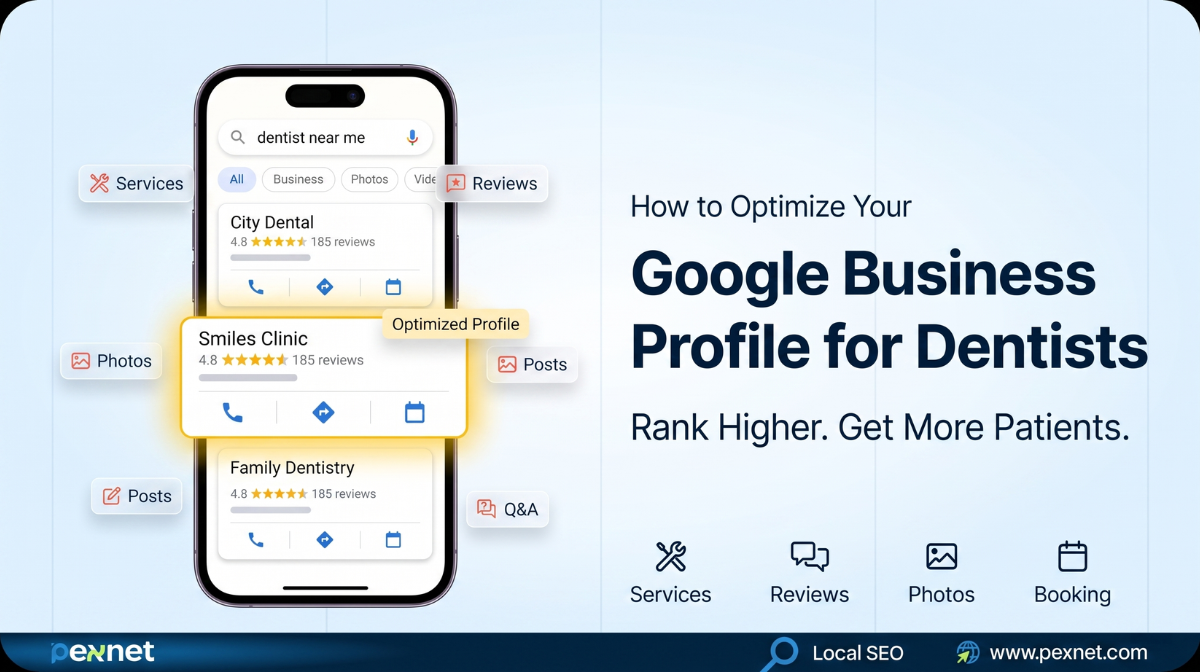
Your Google Business Profile (GBP) is the most important part of local SEO. But most dental clinics leave large parts of it blank.
Here’s what to fill out completely:
- Business name, address, and phone number (NAP)
- Primary category: “Dentist”, add secondary categories for any specialties (e.g., “Cosmetic Dentist,” “Orthodontist,” “Pediatric Dentist”)
- All services with individual descriptions
- Business hours, including holiday hours
- A complete, keyword-rich business description (750 characters max)
- Website link, appointment link, and attributes
Remember that fully completed profiles appear 80% more often in local searches than incomplete ones.
2. Use a Smart GBP Photo Strategy
You already know you need to add high-quality photos. But the question is: which photos matter most?
Upload these specifically:
- Exterior photo: patients need to recognize your building when they arrive
- Reception area: reduce new patient anxiety before their first visit
- Treatment room: show cleanliness and modern equipment
- Team photos: people book dentists they feel comfortable with
- Before-and-after images (with patient consent): high impact for cosmetic services
Add new photos regularly because profiles with consistent photo updates signal to Google that your business is active.
3. Post on Your GBP Every Week
Google Business Posts work like a mini social feed directly on your Google listing. They also keep your profile active.
Post about:
- Seasonal offers (back-to-school checkups, new year teeth whitening)
- New services or equipment
- Team introductions
- Patient education tips
- Holiday hours
Based on experience, we’ve seen that one post per week is enough. It takes just 10 minutes and directly supports your Map Pack ranking.
4. Build a Review System, Not a One-Time Ask
Reviews are a direct local ranking factor. You become trustable when you have more positive reviews and higher rating than other practices in your area.
Here’s a review system that works:
- Ask every patient at checkout verbally, not just a text message
- Send a direct review link via SMS immediately after the appointment
- Train your front desk to make the ask part of the checkout routine
- Respond to every single review (positive and negative) within 48 hours
5. Set Your Service Area Correctly
If you serve patients beyond your clinic’s immediate address, your GBP service area settings matter. Go into your profile and add every city, suburb, and neighborhood you serve.
This expands which local searches your profile is eligible to appear in, especially for searches like “dentist near (suburb)” where you don’t have a physical location but do serve that area.
6. Fix Your Page Titles First
Your page title (also called the title tag) is what appears in the browser tab and in Google search results.
Here’s an example of how to write titles:
A weak title: “Home | Smith Family Dentistry”
A strong title: “Family Dentist in Austin, TX | Smith Family Dentistry”
Every page should have a unique title that includes:
- The primary service or topic for that page
- Your city or service area
- Your practice name (at the end)
7. Write Proper Meta Descriptions
Meta descriptions don’t directly affect rankings, but they affect your click-through rate, which does. If your descriptions are auto-generated or blank, you’re leaving clicks on the table.
A good meta description for a dental clinic:
- Includes your focus keyword naturally
- Mentions your city
- Has a soft action prompt (“Book your appointment today” or “See if we’re accepting new patients”)
- Stays under 160 characters
8. Create a Dedicated Page for Every Major Service
One common mistake: putting all your services on a single page. Each major service deserves its own page.
- General dentistry
- Teeth whitening
- Dental implants
- Invisalign / clear aligners
- Emergency dental care
- Pediatric dentistry
- Root canal treatment
- Dental crowns and bridges
Each page should target a specific keyword like “dental implants in (City)” and answer every question a patient might have before booking, what the procedure involves, how long it takes, what it costs, and what recovery looks like.
9. Add Your City to Your H1 Heading
Your H1 is the main heading on any page. We noticed many dental websites have H1s like “Welcome to Our Practice” or “We Care About Your Smile.” They do nothing for local SEO.
Change your homepage H1 to something like:
“Trusted Family Dentist in (City, State)”
For service pages:
“Dental Implants in [City], Restore Your Smile with Confidence”
This small change tells Google exactly what you do and where you do it.
10. Fix Your URLs
Messy URLs like /page?id=482 or /services/dentalcare1 confuse Google and hurt your rankings.
Clean URLs follow this format:
- /dental-implants-austin-tx/
- /teeth-whitening-downtown-houston/
- /emergency-dentist-chicago/
Keep them short, keyword-rich, location-specific. If your current URLs are a mess, prioritize fixing your highest-traffic pages first.
11. Keep Your NAP Same Everywhere
NAP stands for Name, Address, Phone number. These three pieces of information need to be identical in every platform where your clinic appears, including your website, GBP, Yelp, Healthgrades, Zocdoc, Facebook, local directories, and anywhere else.
Even minor differences like “St.” vs “Street,” a different phone number format, or a missing suite number send conflicting signals to Google.
Here’s how to do a quick audit: Google your practice name and check the top 10 results. Fix any inconsistency you find.
12. Build Citations on the Right Directories
In short, citations are online listings of your clinic’s NAP information. For dental clinics, the most important ones to be listed on are:
- Google Business Profile
- Yelp
- Healthgrades
- Zocdoc
- WebMD Health
- RateMDs
- Vitals
- Facebook Business
- Apple Maps
- Bing Places
- Your local Chamber of Commerce
13. Build Location Pages for Every Area You Serve
If your clinic serves multiple cities or suburbs, each one needs its own page, not a copy-paste template with the city name swapped out.
A good location page includes:
- Locally relevant content (mention specific neighborhoods, landmarks, or common patient concerns in that area)
- The full address and phone number for that location
- An embedded Google Map
- A few patient reviews from that area if possible
- A clear booking call to action
14. Get a Local Backlink from Your Chamber of Commerce
Links from reputable, local websites are still one of the strongest local ranking signals that you can’t ignore.
Your local Chamber of Commerce is the easiest one to get. Join if you’re not already a member. Your listing there not only gives you a credible backlink but also helps build community trust.
Other local backlinks worth pursuing:
- Sponsorships of local schools or sports teams
- Guest contributions to local health blogs or community newsletters
- Partnerships with local medical providers (e.g. GP offices or specialists)
15. Check Your Site Speed, Right Now
Did you know a one-second delay in page load time can reduce conversions by up to 7%? For a dental clinic’s website, that’s a real appointment you didn’t book.
Go to Google PageSpeed Insights and run your homepage. If you score below 70 on mobile, here are the most common fixes:
- Compressing large images
- Removing unnecessary plugins
- Enabling browser caching
- Switching to faster hosting
16. Make Sure Your Site Works on Mobile
More than 60% of dental searches happen on a mobile device.
If your site isn’t mobile-friendly because it’s hard to navigate on a phone, has small text or buttons too close together, or forms that don’t work properly, you’re pushing patients away before they book.
Check your site on your own phone right now. Ask yourself:
- Is the phone number clickable to call directly?
- Can someone find your address and get directions in under 10 seconds?
- Is the “Book Appointment” button visible without scrolling?
If the answer to any of these is no, that needs to be fixed before anything else.
17. Add Schema Markup to Your Key Pages
Schema markup is code that helps Google understand your content better, and display it more visibly in search results.
For dental clinics, the most useful types are:
- LocalBusiness / Dentist schema: your practice name, address, phone, hours
- FAQPage schema: makes FAQ sections eligible for Google’s rich results
- Review schema: to display your star rating directly in search results
You really don’t need to know how to code because tools like Google’s Structured Data Markup Helper or Schema.org generators let you create and add schema without writing a single line of code.
18. Build E-E-A-T Signals Into Your Website
In case you didn’t know, dental content falls under Google’s YMYL (Your Money or Your Life) category since it could affect someone’s health. That means Google holds dental websites to a higher standard of trust and expertise.
E-E-A-T stands for Experience, Expertise, Authoritativeness, and Trustworthiness. Here’s how to signal it:
- Add an “About the Doctor” page with credentials, years of experience, dental school, and specializations
- Sign blog posts with the treating dentist’s name, not just the practice
- Display certifications and memberships (e.g. ADA, state dental associations, specialty boards) on your site
- Show real photos of your team, not stock photos
- Add a patient privacy and HIPAA compliance statement
19. Write Blogs to Answer Real Patient Questions
The goal of a blog isn’t just to get lots of random visitors, but to attract the right people at the right moment.
The best topics are questions like these your front desk hears every week:
- “How much does a dental implant cost in [City]?”
- “Does teeth whitening hurt?”
- “What should I do if I have a dental emergency?”
- “How long does Invisalign take?”
- “Is a dental crown painful?”
Write one post per question and answer it thoroughly. Include your city naturally in the content.
20. Reduce Booking Friction on Every Page
This last dental SEO tip connects SEO to what it’s meant for: getting more patients in the chair.
Every visitor who lands on your site and leaves without booking is a missed opportunity, and many clinics make it harder to book than it needs to be.
Here’s what a friction-free booking experience looks like:
- Clickable phone number in the header on every page
- Visible “Book Appointment” button above the fold, not buried in the footer
- Online booking form that works on mobile and takes under 2 minutes to complete
- Clear confirmation message after submission so patients know it went through
Quick-Check: Where Does Your Clinic Stand?
Run through this list honestly:
| Area | What to Check |
| Google Business Profile | Fully completed? Regular posts? Weekly new reviews? |
| On-Page SEO | City in page titles, H1s, and meta descriptions? |
| Service Pages | One page per major service, not all on one page? |
| NAP Consistency | Identical name, address, phone everywhere online? |
| Site Speed | Scores 70+ on Google PageSpeed mobile? |
| Mobile Experience | Phone clickable? Booking button visible without scrolling? |
| Schema Markup | LocalBusiness + FAQ schema installed? |
| E-E-A-T Signals | Doctor bio, credentials, certifications visible on site? |
| Blog Content | At least one post answering common patient questions? |
| Booking Flow | Patient can book in under 2 minutes? |
If you checked “no” on three or more of these, your clinic has clear gaps that are costing you patients right now.
Conclusion
Our dental SEO tips cover everything – from the quick wins you can implement today to the longer-term strategies that build lasting visibility. But you don’t need to do it all at once, start with your Google Business Profile, fix your page titles, and check your NAP consistency. Those three steps alone can move the needle.
If you want to know exactly where your clinic stands right now, which gaps are costing you the most patients and what to fix first, we offer a free dental SEO audit at Pexnet. We’ll review your GBP, your website, your local rankings, and your competitors, then give you a clear picture of what’s holding you back.
FAQs
How long does dental SEO take to show results?
Most dental clinics start seeing meaningful improvement within 3-6 months of consistent SEO work. However, quick wins like GBP optimization, page title fixes, and NAP corrections can show results faster, sometimes within 4-8 weeks.
Which dental SEO tip should I start with first?
Your Google Business Profile. If it’s incomplete or inactive, fixing it is the single highest-impact change you can make. After that, move to page titles and NAP consistency.
Do I need an SEO agency or can I do this myself?
You can follow some of these tips yourself, such as, GBP optimization, title tags, NAP audits, content writing. But you might need professional help for competitive market research, multi-location clinics, and technical SEO (schema, site speed, structured data).
Is dental SEO different from regular SEO?
Yes, dental content is classified as YMYL (Your Money or Your Life) by Google, meaning it gets more scrutiny. E-E-A-T signals, credentials, clinical accuracy, and authorship matter more for dental sites than for most other industries.
How important are online reviews for dental SEO?
A lot. Review quantity, recency, average rating, and your response rate all factor into your local Map Pack ranking. Reviews also directly influence whether a patient chooses to book, so they affect both your rankings and your conversion rate.
What’s the most common dental SEO mistake?
Having no location-specific content. A website with generic service pages and no city-specific information is literally invisible in local search.

Md Riadul Islam
Carpet Cleaning SEO Specialist
With over 10 years of experience, Riadul is passionate about helping local, independent businesses succeed.
He’s now focused on AI’s impacts on niche websites since aside from Google, people are also using different AI platforms for carpet cleaning services.
He found that while Google cares about content relevance and website authority, AI relies more on trust and credibility to determine recommendations. That’s why he prioritises strengthening trust signals for our clients.
Riadul believes that sustainable growth comes from combining strong branding, deep customer trust, and smart SEO approaches. At Pexnet, he shares the strategies, frameworks, and real-world lessons he has refined over a decade.
Get Quality Leads from Us
PexNet Newsletter - Subscribe for SEO news, trends, updates, & more.
Share this job post


Related Posts

We’re All Ears!
A simple, open conversation can create new doorways to your professional and business success. Don’t hesitate. Take the first step right now.