How to Grow Your Restoration Business in 2026

Restoration SEO
19 May
Last updated: 26 May
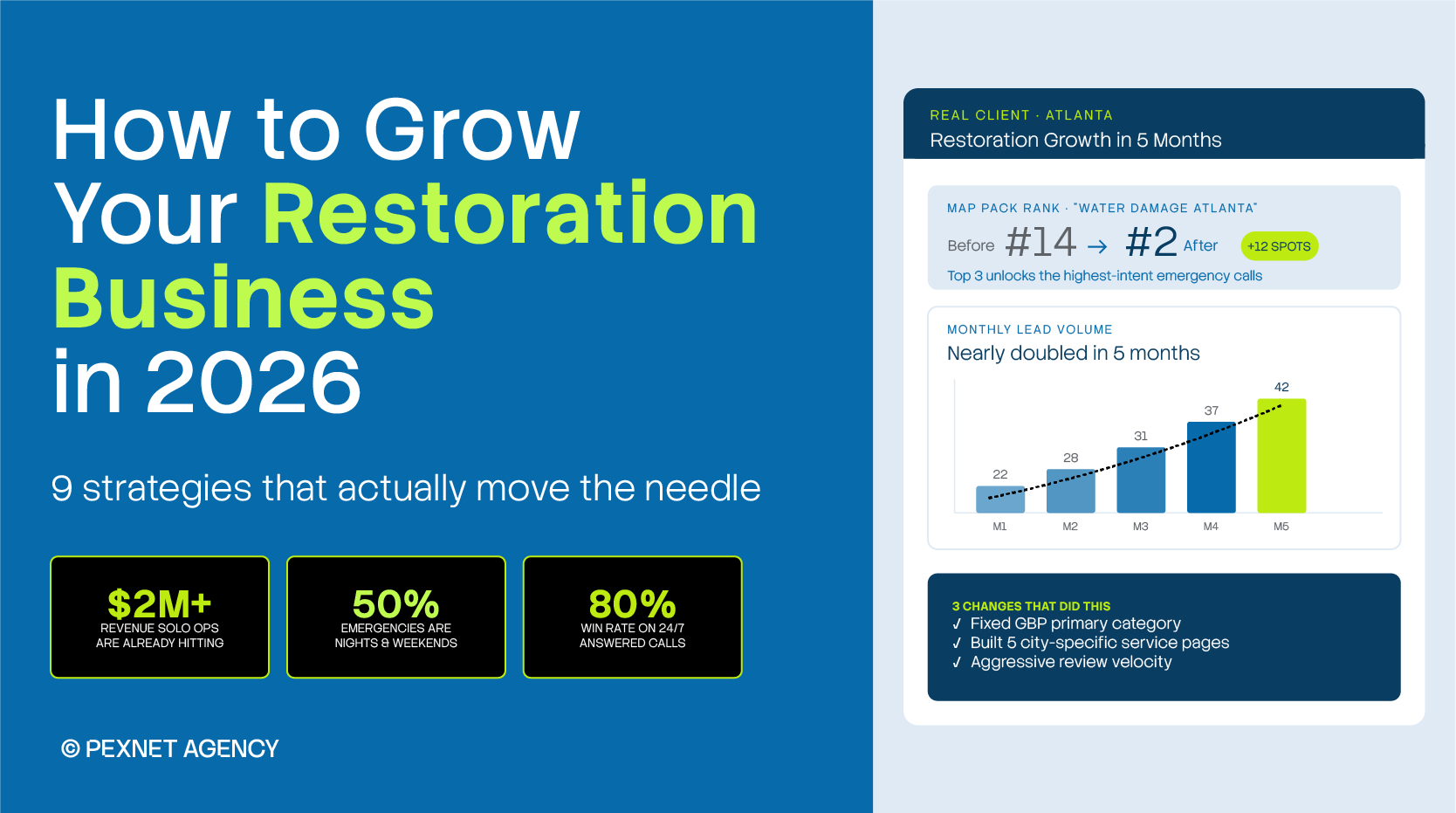
The restoration industry in the U.S. is tough for small businesses. You’re competing against big players like SERVPRO, ServiceMaster, PuroClean, and a dozen other franchises with 8-figure marketing budgets.
There are emergency calls to respond to at 2 a.m. You’re also handling insurance adjusters, crew schedules, equipment rentals, and so on. But somewhere out there, a single-truck water damage operation is doing $1M+ a year. Guess what? They’re not really working harder than you.
At Pexnet, our restoration SEO team has worked with restoration companies of all sizes, from solo operators in suburban Texas to multi-location regional players in the Northeast. We’ve seen that any restoration company can grow with the right strategy. The companies that scale follow a pattern, and we’ll talk about this in detail today.
What Could Stall Your Restoration Business’s Growth
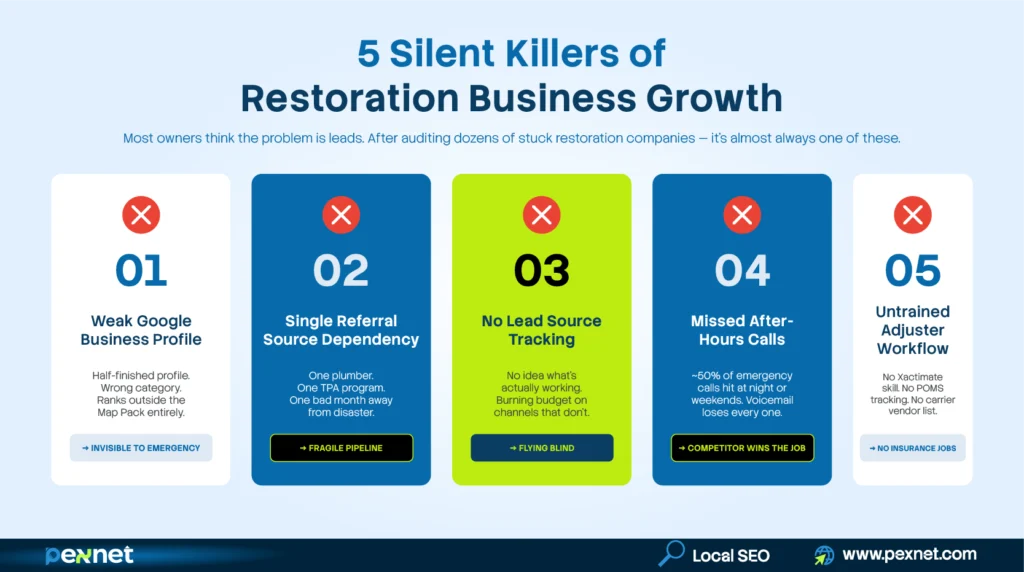
We can mention lots and lots of issues that might be hurting your growth. But here’re the most common ones we see our clients struggling with:
- They miss after-hours calls – the moment most emergency customers reach out
- They depend on a few referral sources (usually a couple of plumber or one TPA program)
- Their Google Business Profile (GBP) is half-finished and ranks outside the Map Pack
- They don’t track where their leads come from, so they keep spending on channels that don’t work
- They’ve never trained anyone to handle insurance adjuster relationships professionally
If any of them sound familiar to you, try the solutions below.
Note: We recommend that you first pick the two or three that match your biggest gap, focus there for around 90 days, and then move to the next priorities.
How to Grow Your Restoration Business?
Online Strategies to Get Emergency Leads
Since most of your clients are searching for restoration services online, you need a robust web presence. Here’s what to do:
1. Boost Your Online Presence First
You’ve to take your place on Google’s map pack. It’s the first three most credible businesses that Google shows on top of search results.
Here are the most important things to do to boost your local rankings:
- Set your primary GBP category to your main restoration service
If you mainly provide Water Damage Restoration Service, don’t pick the general “Restoration Service” or “Cleaning Service” as your primary GBP category.
- Build unique location pages for every city you serve
The same template with the city name swapped will do no good. Create unique, informative, and helpful content with local landmarks, real reviews from that area, and city-specific service details.
- Get reviews aggressively
You need a system to get lots of reviews.
Send a direct review link through email or SMS within 24 hours after every job. Since restoration customers are emotional after a crisis is resolved, they’re more willing to leave reviews than other niches.
Also, train your techs to mention the review request in person before they leave.
Reply to every review within 48 hours, including the bad ones since both adjusters and customers read your responses.
We recommend that you target 100+ Google reviews with a 4.7+ average as soon as you can.
- Track your Map Pack rankings in your service area
A single ranking from your office address will be lying to you. Use a geo-grid tool to see where you rank in your service area.
2. Stop Burning Cash on Standard Google Ads
Restoration is one of the most expensive ad keywords in America’s paid search market. “Water damage restoration” costs anywhere from $40 to $150+ per click depending on your metro.
Google Ads will burn through your budget fast without conversion tracking and a tight quality score. So, here’s what to do instead:
- Shift your most paid spend to Google Local Service Ads (LSA)
LSA charges per qualified lead (not per click), and Google pre-filters the leads. For restoration in 2026, LSA almost always outperforms regular search ads on cost per acquired job.
Also, get the Google Guaranteed badge while you’re at it because it directly impacts your LSA ranking and trust.
- Get the Google Guaranteed badge
It directly impacts your LSA ranking and customer trust.
- Track every lead source
If you don’t know whether a call came from your GBP, LSA, organic search, or referral, you’re flying blind on where to invest next.
- Invest in geo-targeted content
For organic SEO, competing on broad terms is the wrong approach. “Burst pipe cleanup (City Name)” is winnable, while “Water damage restoration” alone almost isn’t.
3. Optimize Your Website for the Panicked Searcher
Yes, your website still matters; but in a different way than it did five years ago.
Looking professional isn’t enough today. You should have every component to convert the emergency searcher who’s panicking on their phone at 1 a.m.
Here’s what converts on a restoration website:
- Click-to-call button above the fold on mobile
The person searching for restoration help is mid-crisis, so they shouldn’t be scrolling to find your phone number.
- “24/7 Emergency” messaging visible immediately
If you don’t show this clearly, visitors might assume you’re closed now.
- Real photos of your trucks, crew, and completed jobs
Stock photos kill trust in this industry because customers want proof that you’re local and real.
- Service-specific pages, not one “Services” page
Whether water damage, fire damage, or mold, make sure every service gets its own page. Each one should be optimized for the specific search intent.
- Insurance section
Don’t forget to mention the carriers you work with, your TPA partnerships, and that you handle claims directly.
- Live testimonials and recent reviews
They should be pulled directly from Google so they update automatically.
4. Cater to the After-Hours and Weekend Calls
Here’s our preferred setup:
- Hire a real 24/7 answering service: forget about voicemails or chatbots. A live human service costs $150-$300/month and pays for itself with a single saved job.
- Use a call-tracking number: this is important to you know which channel drove that 2 a.m. call. You can’t grow what you can’t measure.
- Train your team to ask three things: where the damage is, what type, and whether they need emergency dispatch.
5. Get Visible on AI Platforms
AI is changing our search behavior fast. Aside from search engines, you also need to be there when someone asks ChatGPT, Perplexity, or Gemini “best water damage company in (city),”
How to get referrals from AI assistants?
AI platforms pull your data from your GBP, your reviews, and “best of” listicle pages on local news sites and directories.
So, implement a customized local SEO strategy, get listed on local news roundups, and add a clear FAQ section on your website.
Then check yourself monthly: open ChatGPT in incognito, ask “best water damage company in (your city),” and see if you show up.
Offline Strategies to Build the Next 5 Years of Referrals
Online strategies capture the customer in crisis today, but offline strategies help build the relationships that send you customers for the next decade.
6. Develop Meaningful Insurance Adjuster Relationships
Insurance adjusters refer jobs constantly. They prefer professional and trustable contractors that document properly, handle Xactimate estimates correctly, communicate clearly, and don’t create headaches during the claims process.
Here are the steps to take:
- Apply to your preferred vendor programs with the major carriers in your region, such as State Farm, Allstate, Liberty Mutual, Travelers, USAA, Farmers, Nationwide.
- Earn the certifications adjusters look for, including IICRC (Water Damage, Fire & Smoke, Mold), RIA membership, or Xactimate proficiency badges.
- Build direct relationships with 3-5 local independent adjusters. Take them to lunch or send holiday gifts. They are your most valuable referral partners – far more than plumbers or general contractors.
- Stay on top of POMS scores if you’re already in TPA programs. A low POMS score will kill your assignment count.
7. Diversify Your Referral Sources Beyond Plumbers
We’ve seen many local restoration owners build a network of just 2-3 plumbers. That’s a fragile setup since if one plumber retires or moves, your lead pipeline takes a hit.
You better expand your referral partner list to include:
- Plumbers (still the top source for water damage): build a structured referral program with reciprocal jobs or referral fees (if legal in your state).
- Real estate agents and property managers: they handle hundreds of properties and need a trusted restoration contact.
- Insurance agents (not just adjusters): local State Farm and Allstate agents talk to clients filing claims daily.
- HVAC technicians: they’re the first to spot water damage from leaks in air handlers and ductwork.
- Roofers: the first responders after storm damage.
- Mold inspectors: every mold finding turns into a remediation job.
Note: Try to have 5-7 active referral channels so each can contribute 10-15% of your monthly leads.
8. Use Your Trucks & Job Sites as Offline Marketing
Don’t leave your car with a bland white panel. When your truck spends two days parked outside a flooded house, everyone passing by sees it.
Since this is a great free marketing method, make every truck a rolling billboard:
- Professional vehicle wrap: try a full wrap with your phone number (large enough to read from across the street), your service categories (“Water · Fire · Mold”), and your Google rating (“4.9★ on Google”)
- Yard sign: place it in the front yard of every job with permission from the homeowner for the whole duration of the work. A simple “(Your Company) On-Site” sign with your phone number will work wonders in flood-prone neighborhoods.
- Door hangers: distribute them to 20-30 homes around every job site after the work wraps.
- Direct mail postcards: send these postcards to neighborhoods that just had a weather event e.g. hailstorm, freeze, or flooding. Many don’t know that EDDM (Every Door Direct Mail) through USPS is cheaper under 20 cents per piece.
9. Get Embedded in Your Local Community
People who hear about you from a neighbor or community connection usually convert at 2–3× the rate of cold online leads.
Here’s what works in restoration:
- Join your local chamber of commerce: Show up to their events because property managers and commercial real estate agents are at every chamber meeting.
- Join a BNI (Business Network International) chapter: One restoration company per chapter, weekly meetings, formal referral exchange. Boring? Yes. Effective? Painfully so.
- Sponsor a local youth sports team, school event, or community fundraiser: Your logo on a banner at a Little League field might be seen by thousands of local parents.
- Speak at community events about disaster prep: Free 30-minute talks at HOAs, senior centers, and homeowner associations about “what to do in the first hour of water damage” will position you as the trusted restoration expert in your community.
- Show up after major weather events: Be physically present in the affected neighborhoods within 24 hours with your branded shirt, business cards, and business truck visible. This is important because we’ve watched restoration companies build empires just by showing up immediately after a disaster.
10. Streamline Your Operations Before You Scale Anything
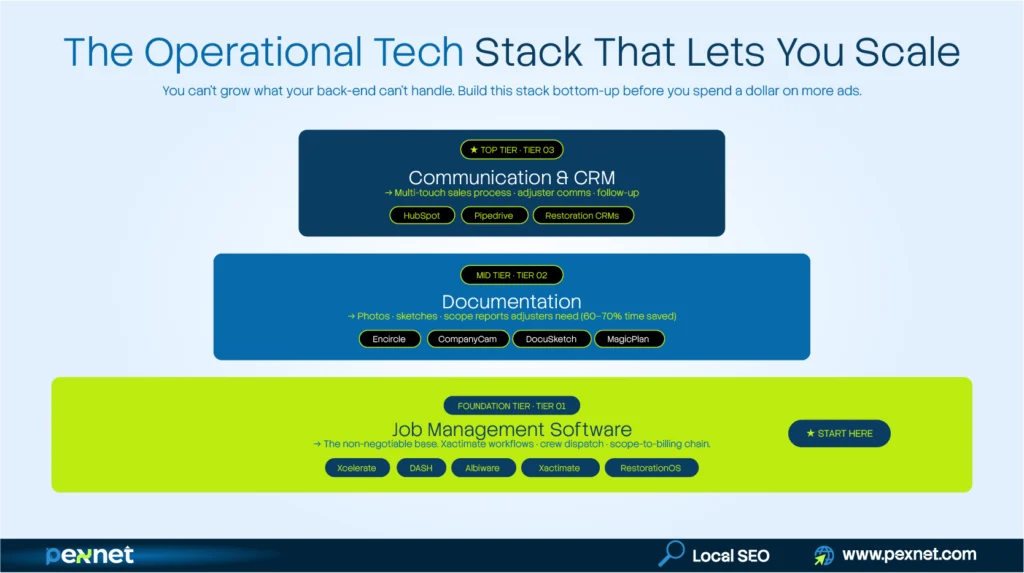
Naturally, you can’t grow your restoration company if your back-end can’t handle more volume.
Be aware of these operational gaps that can halt your growth:
- Slow estimating
If your Xactimate turnaround is 48+ hours, you might be losing jobs to faster competitors. So, aim for 24 hours or less.
- Reactive scheduling
Dispatching crews without a plan might create chaos e.g. techs waiting on-site, materials arriving late, multiple supply runs. Plan every job in phases carefully before dispatch.
- Manual documentation
Tools like Encircle, CompanyCam, and DocuSketch cut your documentation time by 60-70%. They also help generate the kind of detailed reports adjusters love.
- No CRM
Restoration is a multi-touch sales process – initial call, estimate, scope approval, work, billing, or follow-up. Without a CRM like Xcelerate, DASH, Albiware, or even a properly configured HubSpot, your valuable leads might slip through cracks.
11. Build a Team That Can Run Without You
Did you know many restoration businesses hit a ceiling around $750K-$1.5M because everything depends on the owner? You estimate every job, manage every adjuster relationship, and handle every escalation.
Here’s what to do to break through:
- Hire a Project Manager first
Before bringing on estimators or additional techs, get a PM who can handle jobs from start to finish so you concentrate on increasing your sales volume.
- Document your processes
Almost every business broker we’ve talked to says the same thing – companies with documented systems sell for 2-3x higher multiples than those without. Even if you never sell, documented processes will help reduce your training time dramatically.
- Cross-train your crew
A water tech who can also handle basic fire/smoke work is twice as valuable as one who can’t.
- Invest in IICRC certifications for your team
Adjusters and customers both check for them, and certified crews can charge higher pricing.
12. Diversify Your Service Offerings Strategically
Don’t keep your restoration service limited to just water damage. We recommend that you add complementary services that share the same customers and equipment.
Our recommend order:
- Water damage (base service)
- Mold remediation (natural extension – mold often follows water damage)
- Fire & smoke damage (uses similar drying equipment and adjuster relationships)
- Sewage cleanup / biohazard (high-margin, low-competition)
- Reconstruction / build-back (highest margin per job, captures full insurance claim value)
Skip the urge to add unrelated services like generic cleaning or general contracting. Stick to disaster-adjacent services where you can leverage your existing certifications, equipment, and adjuster network.
Pro Tip: Adding build-back/reconstruction is the single biggest revenue multiplier for established restoration companies. A typical water mitigation job is $3K–$8K, while the same job with reconstruction included is often $25K–$60K (5x the revenue!).
The Bridge Strategy
This is a highly effective way to turn every job into content for both your online and offline audience.
13. Film Before-And-After Videos & Publish Everywhere
Restoration is uniquely suited to video because the transformation is dramatic e.g. three feet of standing water on Monday, a spotless dry basement by Friday!
Here’s how to build this into your operations without it becoming a burden on your crew:
- Make filming part of the standard job checklist
On day one before any work begins, instruct the lead tech to shoot 30 seconds of vertical footage of the damage with their phone.
Use the same angles every time: wide shot of the room, close-up of the worst damage, and slow pan showing the extent.
After the job wraps, the same tech should reshoot the same angles.
- Get written homeowner permission upfront
Add this simple line to your service agreement: “Customer grants permission to use before/after photos and video for marketing purposes, with no identifying personal details shown.”
Clients usually say yes because they’re proud their home was saved.
- Edit in CapCut on a phone
Use this free app, which takes 15 minutes per video. Add captions, your logo, your phone number, and a city tag.
- Distribute the same clip to top channels
We’re talking about YouTube (both long-form and Shorts), TikTok, Instagram Reels, Facebook (your business page + local community groups), your website’s service page, and your Google Business Profile as a Post.
Every channel works for a different reason. TikTok has the highest organic reach for restoration content right now – we’ve watched dramatic mold remediation clips get 100K+ views from a single posting in a metro area of 500K.
YouTube long-form drives search traffic for years (a “water damage restoration in (city)” video can rank for that exact term).
Instagram Reels reaches local homeowners and property managers, while Facebook reaches your service area, especially in local groups.
Pro Tip: Our recommended publishing cadence is one new before-and-after clip per week, distributed across all six channels the same day.
Restoration Business Growth Strategy: Comparison Chart
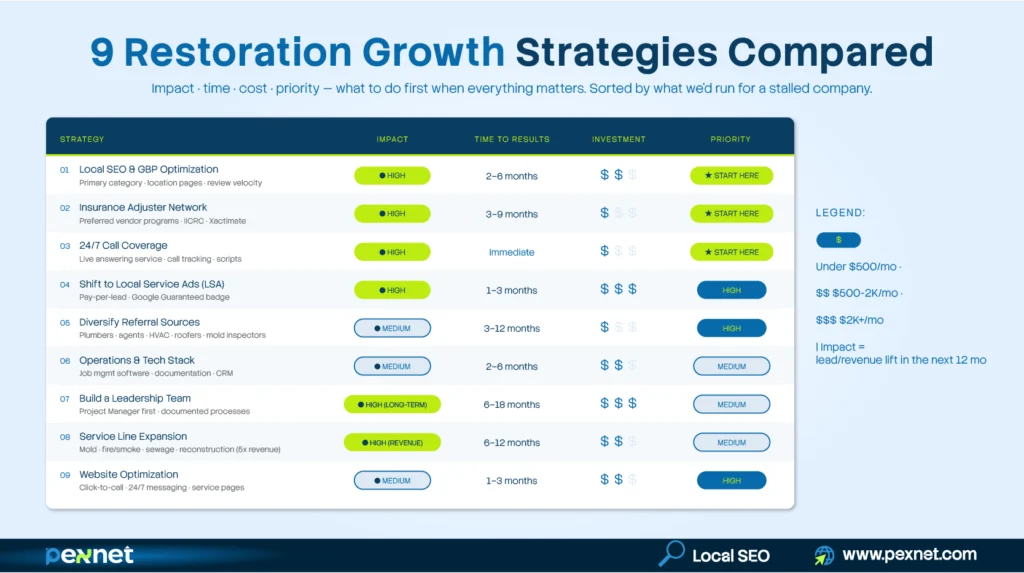
Here’s how the 9 strategies stack up by impact, time investment, and cost. Use this to prioritize.
| Strategy | Impact | Time to See Results | Investment | Priority |
| 1. Local SEO & GBP optimization | 🟢 High | 2–6 months | $$ | ⭐ Start here |
| 2. Insurance adjuster network | 🟢 High | 3–9 months | $ | ⭐ Start here |
| 3. 24/7 call coverage | 🟢 High | Immediate | $ | ⭐ Start here |
| 4. Shift to LSA from search ads | 🟢 High | 1–3 months | $$$ | High |
| 5. Diversify referral sources | 🟡 Medium | 3–12 months | $ | High |
| 6. Operations & tech stack | 🟡 Medium | 2–6 months | $$ | Medium |
| 7. Build leadership team | 🟢 High (long-term) | 6–18 months | $$$ | Medium |
| 8. Service line expansion | 🟢 High (revenue) | 6–12 months | $$ | Medium |
| 9. Website optimization | 🟡 Medium | 1–3 months | $$ | High |
Our 90-Day Growth Plan for Your Stalled Restoration Company
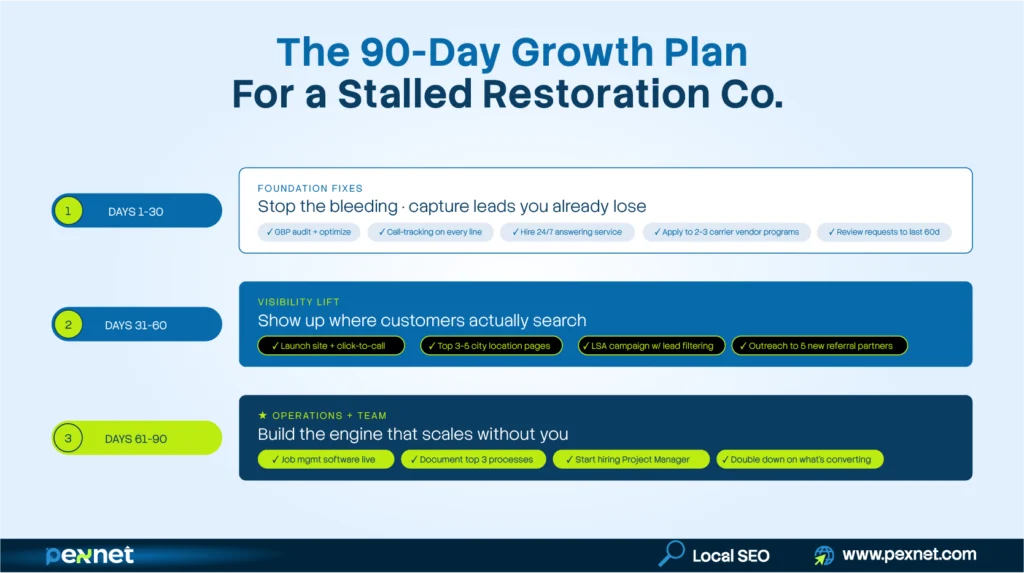
If we were sitting down with a struggling restoration owner tomorrow, here’s the exact 90-day roadmap we’d hand them.
Days 1–30: Foundation Fixes
- Audit and optimize your Google Business Profile (correct category, hours, photos, services)
- Set up call-tracking on every channel
- Hire 24/7 answering service
- Apply to 2-3 carrier preferred vendor programs
- Send review requests to last 60 days of completed jobs
Days 31–60: Visibility Lift
- Launch (or rebuild) the website with proper service pages and click-to-call
- Begin the location page rollout for top 3–5 cities in your service area
- Start a Local Service Ads campaign with proper budget and lead filtering
- Identify and outreach to 5 potential referral partners (plumbers, agents, property managers)
Days 61–90: Operations + Team
- Implement or upgrade job management software
- Document your top 3 processes (estimating, dispatching, billing)
- Hire a Project Manager if you’re owner-dependent
- Review lead source data from days 1-60 and double down on what’s working
By day 90, most of our clients see lead volume up 30–60%, revenue per job up 10–20% from better operations, and a clearer picture of where the next year’s growth will come from.
Common Mistakes to Avoid
After working with restoration companies across the U.S., these are the mistakes we see repeatedly. Avoid all of these.
1. Not being serious about marketing
“We tried Google Ads, didn’t work” or “we don’t need SEO, we get all our work from referrals” – both attitudes can cap your growth.
Spending on marketing before fixing operations
If your estimating is slow or your team can’t handle more volume, adding leads creates chaos, not growth.
2. Depending on one channel
Companies that get 80%+ of leads from a single TPA, plumber, or ad platform are one bad month away from disaster.
3. Not tracking where leads come from
Without source attribution, you’re guessing – and guessing wrong is expensive in restoration.
4. Ignoring reviews
A competitor with 200 reviews beats your 30 every time in the Map Pack, regardless of who does better work.
5. Trying to compete on price
Restoration is an emergency service. Customers care about response time, trust, and insurance handling. Lowering the price just shrinks your margins.
6. Underinvesting in IICRC certifications
Adjusters explicitly look for these. So do better-paying commercial clients.
7. Investing in trucks but not wraps
There’s no doubt that buying a $40K work truck and skipping the $3K wrap is leaving thousands of dollars of free marketing on the table.
8. Skipping the offline plumbing
We always say that restoration is a relationship industry, so build your own community.
9. Not filming your jobs
Every restoration job is a piece of marketing. Skipping the 60 seconds of video documentation throws away the highest-engagement content you’ll ever produce.

Md Riadul Islam
Carpet Cleaning SEO Specialist
With over 10 years of experience, Riadul is passionate about helping local, independent businesses succeed.
He’s now focused on AI’s impacts on niche websites since aside from Google, people are also using different AI platforms for carpet cleaning services.
He found that while Google cares about content relevance and website authority, AI relies more on trust and credibility to determine recommendations. That’s why he prioritises strengthening trust signals for our clients.
Riadul believes that sustainable growth comes from combining strong branding, deep customer trust, and smart SEO approaches. At Pexnet, he shares the strategies, frameworks, and real-world lessons he has refined over a decade.
Get Quality Leads from Us
PexNet Newsletter - Subscribe for SEO news, trends, updates, & more.
Share this job post


Related Posts

We’re All Ears!
A simple, open conversation can create new doorways to your professional and business success. Don’t hesitate. Take the first step right now.